Surah Al Falaq


Surah Al-Falaq (The Daybreak)

Surah Al-Falaq (The Daybreak)
Bismillah Ar-Rahman Ar-Raheem
Qul-a'udhu bi Rabb il-falaq
Min sharri ma khalaq
Wa min sharri ghasiqin 'idha waqab
Wa min sharr-in-naffathati fi-l-'uqad
Wa min sharri hasidin idha hasad
In the name of Allah, the Most Beneficent, the Most Merciful.
Say: "I seek refuge in the Lord of Daybreak
From the evil of that which He created;
From the evil of the darkness when it is intense,
And from the evil of malignant witchcraft,
And from the evil of the envier when he envieth.

The Ability to Eat


Last Friday (April 9, 2004), we had the opportunity to visit a sick brother in a Hospital in East York, Canada. This brother had an infection in his stomach which caused it to explode. As a result, the doctors had to remove half of his stomach through an operation. For seven days, he is unable to eat or drink anything. Nutrients are being provided to him by using specialized methods. During our visit, we told him to be patient and pray to Allah for quick recovery. At one point, the brother made a very important statement. He said, "Now I have understood that if Allah doesn't want, we cannot eat even one grain of rice."

Being able to eat and drink is a great blessing of Allah. How costly and difficult it is to digest one meal without having a stomach! We should thank Allah again and again for letting us digest many meals without having to go through these difficulties.

A Lesson from Disabled People

Once, a visitor was being shown around a leper colony in India. The colony was built to provide a shelter for those people who were poor and had various physical disabilities. At noon a gong (a metal disk that produces a sound when hit with a hammer) sounded to gather the inhabitants for the midday meal. People came from all parts of the compound to the dining hall. Suddenly, everyone started laughing at seeing two young men, one riding on the other's back, pretending to be a horse and a rider. They were having lots of fun. As the visitor watched, he was told that the man who carried his friend was blind, and the man being carried was lame (who couldn't walk). The one who couldn't see used his feet; the one who couldn't walk used his eyes. Together they helped each other and reached their destination.

Let us use each other's strengths to make up for the weaknesses of others. Our strength is in unity, not in division.

The Story of Jazan


Once Abdullah ibn Masud (ra) was passing by an area in the city of Qufa. There, a group of wrong doing people have gathered to have a party. They were engrossed in drinking wine. A singer called Jazan was entertaining them with songs. Jazan had a very beautiful voice. When Abdullah ibn Masud heard his voice while passing by, he said in amazement, "So beautiful is his voice. How wonderful it would be if he had used that voice to recite the Quran!" After saying this, Abdullah covered his head with a cloth and left that place. When Jazan noticed Abdullah ibn Masud leaving, he asked, "Who is that man and what was he saying?" The people in the gathering told him, "He is Abdullah ibn Masud, a companion of Prophet Muhammad (peace be upon him). He said that your voice is very beautiful. How wonderful it would be if you had used your voice to recite the Quran!"


Jazan was struck by his comments. He threw away his musical instrument and ran to Abdullah ibn Masud. The two of them embraced each other and shed tears profusely. Abdullah ibn Masud said to him, "Why should I not love the one who loves Allah?" Thereafter, Jazan repented to Allah and stayed in the company of Abdullah ibn Masud to learn the Quran and other teachings of Islam. He learned to such an extent that he became one of the great scholars of his time.

Source: Obtained from the book "Tambihul Ghafileen" by Shaikh Abul Laith Samarkandi.

A Gift After Hardships


The Prophet Muhammad (peace be upon him) dispatched towards the sea-shore an expedition of three hundred men, under the command of Abu Ubaidah (ra) in 8 A.H. He gave them a bag full of dates for their rations. They had been hardly out for fifteen days when they ran short of rations. In order to provide the contingent with food, Qais (ra) began buying three camels daily from his own men, to feed the Mujahideen, with a promise to pay on return to Madinah. The Amir seeing that the slaugther of camels would deprive the party of their only means of transport, prohibited him to do so. He collected the dates that had been left with each person and stored them in a bag. He would issue one date to each man as his daily ration. When Jabir (ra) later on narrated this story to the people, one of his audience inquired:

"How did you manage to live upon one date only for the whole day?" He replied: "We longed even for that one date, when the whole stock was exhausted. We were on the verge of starvation. We moistened the dry tree-leaves with water and ate them."


When they reached this stage, Allah had mercy on them for He always brings ease after every hardship, provided it is endured patiently. A big fish known as "Ambar" was thrown out of the sea for them. The fish was so big that they lived on it for eighteen days altogether. They also filled their satchels with the remaining portion, which lasted them right up to Madinah. When the episode was narrated to the Prophet (peace be upon him), he said: "The fish was a provision arranged for you by Allah."

Source: From the book "Stories of the Sahabah" by Shaikh Muhammad Zakariyya Kandhalvi.

We are Muslims today because of such sacrifices by the companions of Prophet Muhammad (peace be upon him). We should remember these events as a source of comfort whenever we too are faced with difficulties regarding practising Islam.

An Interview with Muhammad Ali


The following incident took place during an interview with the world famous boxer, Muhammad Ali.

It all started with an innocent question: You have beaten some of the toughest men in the world in the ring. What scares you the most?

Ali: [Points to his wife, to much laughter]

Lonnie Ali: Come on, Muhammad, joking aside, tell them what really scares you.

Ali: Nothing.

Lonnie Ali: Nothing on this earth maybe, but ... tell them Muhammad.
[There is a long pause]

Ali: Not going to heaven.

[Everyone present became silent. Sister Lonnie Ali had tears flowing down her cheeks. Others present were also shaken and silent. A few wiping their eyes. Br. Malik Mujahid broke the silence, patting Muhammad Ali on his arm.]

Malik Mujahid: "No, Insha Allah, you will enter Jannah because you have helped so many people."

Ali: [Muhammad Ali turned his face towards Br. Malik Mujahid, looking at him as though asking: Are you sure? Are you sure about yourself?]

Malik Mujahid: "The Mumin lives between hope and fear."

Where as the toughest man in the world is wondering about his place in Jannah, what do you think about yourself. Will you go to Jannah? Its a question which everyone must ask himself and herself. A good answer may help us focus on the everlasting life.

We pray to Allah for the best of both worlds. If we want Allah to give us the best, we will have to strive for it.

Source: Extracted from the article "Will Muhammad Ali go to Jannah?" by Soundvision.com

Enemy Becomes a Friend


In the sixth year after the hijrah, the Prophet, peace be upon him, decided to expand the scope of his mission. He sent eight letters to rulers in the Arabian peninsula and surrounding areas inviting them to Islam. One of these rulers was Thumamah ibn Uthal.

Thumamah was one of the most powerful Arab rulers in pre-Qur'anic times. This is not surprising since he was a chieftain of the Banu Hanifah and one of the rulers of al- Yamamah whose word no one dared to challenge or disobey.

When Thumamah received the Prophet's letter, he was consumed by anger and rejected it. He refused to listen to the invitation of Truth and goodness. More than that, he felt a strong desire to go and kill the Prophet and bury his mission with him.

Thumamah waited and waited for a convenient time to carry out his design against the Prophet until eventually forgetfulness caused him to lose interest. One of his uncles, however, reminded him of his plan, praising what he intended to do.


In the pursuit of his evil design against the Prophet, Thumamah met and killed a group of the Prophet's companions. The Prophet thereupon declared him a wanted man who could lawfully be killed on sight.

Not long afterwards, Thumamah decided to perform umrah. He wanted to perform tawaf around the Ka'bah and sacrifice to the idols there (The people of Makkah, before becoming Muslims, placed hundreds of idols in the Holy Ka'bah. These idols were later destroyed by the Prophet). So he left al-Yamamah for Makkah. As he was passing near Madinah, an incident took place which he had not anticipated.

Groups of Muslims were patrolling the districts of Madinah and outlying areas on the lookout for any strangers or anyone intent on causing trouble. One of these groups came upon Thumamah and apprehended him but they did not know who he was. They took him to Madinah and tied him to one of the columns in the mosque. They waited for the Prophet himself to question the man and decide what should be done with him.

When the Prophet was about to enter the mosque, he saw Thumamah and asked his companions, "Do you know whom you have taken?"

"No, messenger of God," they replied.

"This is Thumamah ibn Uthal al-Hanafi," he said. "You have done well in capturing him."

The Prophet then returned home to his family and said, "Get what food you can and send it to Thumamah ibn Uthal." He then ordered his camel to be milked for him. All this was done before he met Thumamah or had spoken to him.

The Prophet then approached Thumamah hoping to encourage him to become a Muslim. "What do you have to say for yourself" he asked.

"If you want to kill in reprisal," Thumamah replied, "you can have someone of noble blood to kill. If, out of your bounty, you want to forgive, I shall be grateful. If you want money in compensation, I shall give you whatever amount you ask."

The Prophet then left him for two days, but still personally sent him food and drink and milk from his camel. The Prophet went back to him and asked, "What do you have to say for yourself" Thumamah repeated what he had said the day before. The Prophet then left and came back to him the following day. "What do you have to say for yourself?" he asked again and Thumamah repeated what he had said once more. Then the Prophet turned to his companions and said, "Set him free."

Thumamah left the mosque of the Prophet and rode until he came to a palm grove on the outskirts of Madinah near al-Baqi' (a place of luxuriant vegetation which later became a cemetery for many of the Prophet's companions). He watered his camel and washed himself well. Then he turned back and made his way to the Prophet's mosque. There, he stood before a congregation of Muslims and said:

"I bear witness that there is no god but Allah and I bear witness that Muhammad is His servant and His messenger." He then went to the Prophet, upon whom be peace, and said:

"O Muhammad, by God, there was never on this earth a face more detestable than yours. Now, yours is the dearest face of all to me."

"I have killed some of your men," he continued, "I am at your mercy. What will you have done to me?"

"There is now no blame on you, Thumamah," replied the Prophet. "Becoming a Muslim obliterates past actions and marks a new beginning."

Source: "Companions of The Prophet", Vol.1, By: Abdul Wahid Hamid.

A Home for a Home in Paradise


Abdullah ibn Jahsh (may Allah be pleased with him) was among those who were the first to accept Islam. When the persecution of the Quraysh got severe, the Prophet Muhammad (peace and blessings be upon him) gave permission for his companions to emigrate to Madinah. Emigrating was not a new experience for Abdullah. He and some members of his immediate family had migrated before to Abyssinia. This time, however, his migration was on a far bigger scale. His family and relatives, men, women and children, migrated with him. In fact, his whole clan had become Muslims and accompanied him.

Abdullah's clan were not long gone when the alerted Quraysh leaders came out and made the rounds of the districts in Makkah to find out which Muslims had left and who had remained. Among these leaders were Abu Jahl and Utbah ibn Rabi'ah. Utbah looked at the houses of the Banu Jahsh through which the dusty winds were blowing. He banged on the doors and shouted: "The houses of the Banu Jahsh have become empty and are weeping for its occupants." Abdullah bin Jahsh had the most beautiful and expensive house. He sacrificed this house for the pleasure of Allah. Seeing it abandoned, Abu Jahl entered the house and took all its contents.

Later, when Abdullah ibn Jahsh heard what Abu Jahl had done to his house, he mentioned it to the Prophet, peace be upon him, who said: "Aren't you satisfied, O Abdullah, with what Allah has given you instead, a house in Paradise?"

"Yes, messenger of Allah," replied Abdullah. From that moment he never had any regret for that house and became completely satisfied with the beautiful palaces that are awaiting for him in Paradise.

Source: Partially taken from "Companions of The Prophet", Vol.1, By: Abdul Wahid Hamid.

The Story of Alqamah


At the time of the Prophet (peace be upon him), there was a young man named Alqamah. He was very diligent in obeying Allah by engaging in prayer and fasting and spending in charity. Then he fell ill and his illness became serious. His wife went to the Prophet and said, "My husband, Alqamah, is on his deathbed. I therefore came to tell you, Messenger of Allah, about his condition." The Prophet (then) sent for Ammar or Suhaib and Bilal, and told them to go to him (Alqamah) and have him repeat the Shahadah. Thereupon they went to him and found him in the agony of death. They asked him to say, "La illaha illa Allah," but his tongue was unable to pronounce it. At that, they came and told the Messenger of Allah that he was unable to repeat the Shahadah.

The Prophet asked, "Is either of his parents alive?" He was told, "Messenger of Allah, his mother is, but she is very old." The Prophet sent her a message that if it was convenient for her (that is, is she was able to go out), she should come to him; otherwise she should stay in her house and the Prophet would come to her.


The Prophet's messenger came to her and informed her of the Prophet's message. She said, "May my life be a ransom for him, it is my pleasure to go to him!" She then stood up, leaning on her walking stick, and came to the Prophet and greeted him. The Prophet returned her greeting and said to her, "Umm Alqamah, tell me the truth, for otherwise Allah Most High will reveal the truth to me! What is the situation concerning your son, Alqamah?" She replied, "Messenger of Allah, he prays much, fasts a great deal, and spends a great amount in charity." The Prophet said, "And what about yourself?" She said, "Messenger of Allah, I am angry with him." He said, "Why?" She replied, "Messenger of Allah, he has preferred his wife to me and has disobeyed me." Then Allah's Messenger said, "Umm Alqamah, surely your anger has prevented Alqamah's tongue from pronouncing the Shahadah."

He then turned to Bilal and said, "Bilal, go out and collect a quantity of firewood." She said, "Messenger of Allah, what do you plan to do?" He replied, "I will burn him in front of your eyes." She said, "Messenger of Allah, he is my son! My heart cannot bear your burning him in front of me!" He said, "Umm Alqamah, Allah's punishment is more severe and more lasting! Therefore, if you want Allah to forgive him, be reconciled to him. By the One in Whose Hand is my soul, the prayer, fasting, and spending in charity (which he has done) are of no benefit to Alqamah as long as you are angry with him! Thereupon she said, "Messenger of Allah, I call upon Allah Most High and His angels and the Muslims who are present to be my witnesses that I am pleased with my son Alqamah." Allah's Messenger said, "Bilal, go to him and see whether he is now able to say, "La illaha illa Allah" or not. It may be that Umm Alqamah is saying something for my sake which is not in her heart."

Thereupon Bilal went, and while entering the door he heard Alqamah saying, "La illaha illa Allah." (Concerning this), Bilal remarked, "It is surely true that while Alqamah's mother was angry with him his tongue was tied, and now that she is pleased with him his tongue is freed." Alqamah died the same day. The Prophet came to him and gave the order for his washing and shrouding, and then prayed the funeral prayer for him and buried him. He then stood by the side of his grave and said, "You company of Muhajireen and Helpers, if anyone favors his wife over his mother, Allah and His angels and all the people curse him! Allah does not accept his spending (in charity) and his uprightness unless he repents toward Allah, the Glorious and Majestic, and reconciles with her and attains her pleasure, because Allah's pleasure consists in her pleasure and Allah's anger consists in her anger."

Source: Reported in Tabarani and Ahmed.

We must always be respectful and obedient to our parents. However, we are not to obey them if they order us to disobey Allah and His Prophet. Other than this, they deserve our utmost attention and respect.

The Beautiful Story of Abu Ghayth


From the signs of truthfulness is fear of Allah and asceticism in life; for the truthful with conviction fears consuming from what is impermissible and bears poverty and hardship for the sake of Islam. If he commits sin then he does not sleep until he returns to his Lord and repents, in order to free himself from the sin, and its burden.

Ibn Jarir at-Tabari: I was in Makkah during the season of Hajj and I saw a man from Khurasaan calling out to the people: "Oh pilgrims, oh people of Makkah - from those who are present and those far off, I have lost a pouch that contains a thousand dinars. So whoever returns the pouch, Allah will reward them with good, save them from the hell fire, and His bounty and favors will be acquired on the Day of Accounting (Day of Judgment)."

An old man from the people of Makkah approached him and said: "Oh Khurasaani, our city is in a very tough condition, and the days of hajj are few, and its season is appointed, and the doors of profit-making are closed. This money might fall in the hands of a believer who is poor and old in age. Maybe he plans to give it if you make a promise that you will give him a little bit of money that is halal (permissible) for him to use."


The Khurasaani said: "How much does he want?"

The old man said: "He wants one-tenth of the money (a hundred dinars)."

The Khurasaani said: "No. I will not grant him the money and instead I will take my case to Allah, and complain to Him on the day we meet Him, and Allah is sufficient for us and the best one to trust in."

Ibn Jarir at-Tabari said: "I realized that it was the old man is poor, and he was the one who took the pouch of dinars and wishes to have a little portion of it. So I followed him until he returned to his home. My assumptions were confirmed. I heard him calling onto his wife:"Oh Lubabah."

She said: "I am at your service, O Abu Ghayth."

The old man said: I found the owner of the dinars calling for it, and he does not intend to give any reward to the person who finds it. I said to him "Give us a hundred dinars and he refused and said he would take his case to Allah. What should I do O Lubabah? I must return it, for I fear my Lord, and I fear that my sin is multiplied.

His wife said to him: Oh Man! We have been struggling and suffering from poverty with you for the last 50 years, and you have 4 daughters, 2 sisters, my mother and I, and you are the ninth. Keep all the money and feed us for we are hungry, and clothe us for you know better our situation. Perhaps Allah, the All-Mighty, will make you rich afterwards and you might be able to give the money back after you fed your children, or Allah will pay the amount you owe on the day when the kingdom will belong to the King (Allah).

He said to her: Will I consume haram after 86 years of my life, and burn my organs with fire after I have been patient with my poverty, and become worthy of Allah anger, even though I am close to my grave?! No, By Allah, I will not do so!

Ibn Jarir at-Tabari said: I left with amazement concerning his condition and that of his wife. At a later point during the day, I heard the owner of the pouch calling out...

Saying: "O people of Makkah, O pilgrims, who ever of you find a pouch containing a thousand dinars, let him return it and they shall surely find great reward with Allah."

The old man said: Oh Khurasaani, I have addressed you the other day and advised you that our land is low on cultivation, so reward the person who found the pouch so that he is not tempted to break the laws of Allah. I have advised you to pay the person who finds it a hundred dinars but you refused. If your money falls into hands of a person who fears Allah the All-Mighty, will you give him 10 dinars at least, instead of a 100?

The Khurasaani said: I will not do so, and I will complain to Allah on the day I meet him, and Allah is sufficient for us and the best one to trust in."

Ibn Jarir at-Tabari said: The people dispersed and left. Later on during the hours of the day, once again, the Khurasaani made the same call, saying:

"O people of Makkah, O pilgrims, who ever of you find a pouch containing a thousand dinars, let him return it and they shall surely find great reward with Allah."

The old man came again and said: O Khurasaani, I said to you the day before yesterday to reward the finder a hundred dinars and you refused. Then I advised you to give him ten dinars and you refused, so will you give only one dinar so that he can buy with half of it things he needs and with the other half, sheep milk, so that he can give to the people and feed his children?

The Khurasaani said: I will not do so, and I will complain to Allah on the day I meet him, and Allah is sufficient for us and the best one to trust in. "

The old man angrily said: Come you, and take your money so that I can sleep at night, for I have not had a good mood ever since I found this money.

Ibn Jarir said: So the old man went with the owner of the money and I followed them until the old man entered his house, dug a hole and pulled out the money and said: Take your money and ask Allah to forgive me and bless me from His bounty.

The Khurasaani took the money and intended to leave, but when he reached the door he said: O old man, my father died, May Allah have mercy on him, and left behind three thousand dinars and said to me: Take out a third of this money and give it to a person from the people who is most deserving of it. Therefore I tied it in a pouch so that I may spend it on someone who is worthy of it. By Allah, I have not seen a person, since I left Khurasaan until now, who is more worthy of it then you. So take it, May Allah's blessing be upon you, and May He reward for the trust you kept, and your patience during poverty. The Khurasaani man left without the money.

The old man wept and prayed to Allah, saying: May Allah bless the owner of the money in his grave, and May Allah bless his son.

Ibn Jarir said: I left after the Khurasaani but Abu Ghayth (the old man) followed me and brought me back. He asked me to sit down, and said: I have seen you following me since the first day; you have come to know of our situation yesterday and today. I have heard that the Prophet said: "If you are gifted from the provision of Allah, without begging or asking, then accept it and do not reject it." So this is a gift from Allah to all those attending.

The old man called: O Lubabah, O so and so, O so and so. He called on his daughters and his sisters and wife and her mother, and sat down and made me sit down. We were 10. He opened the bag, and said spread your clothing over your laps.

So I (Ibn Jarir) did, but the girls did not have proper clothing that would enable them to do that, so they extended their hands. The old man gave dinar by dinar in order until he reached me (Ibn Jarir) and said: "Here is a dinar." The process continued until the bag was empty and I received a hundred dinars.

Ibn Jarir at-Tabari said: So joy filled my heart because of the provision they received more then the joy I had because I received a hundred dinars.

When I was leaving the old man said: O young man. You are blessed; keep this money with you for it is halal. And know that I use to wake up for Fajr prayer with this wet shirt. After I was done I would take it off, and give it so that my daughters can pray - one by one. Then I would go to work between Dhuhr prayer and Asr prayer and then I would come back at the end of the day with what Allah has given me from dates and dry pieces of bread. Then I would take off my clothes for my daughters and they would pray Dhuhr prayer and Asr prayer, and the same would happen for the Maghrib and Isha prayers. And we did not ever expect to see this kind of money. So may Allah make us make good use of them, and may Allah bless the person in his grave and multiply the reward for him.

Ibn Jarir said: So I greeted him goodbye, and took the hundred dinars and used them to write knowledge for two years! I used it to buy paper and pay rent and after sixteen years I returned to Makkah and inquired about the old man. I was told that he died a few months after the incident that occurred between us. His wife died, along with her mother, and his 2 sisters. The only ones that remained were the daughters whom, when I asked about, found that they were married to kings and Princes. I dropped by and they honored me as a guest and treated me kindly until they died also. So May Allah bless them in their graves.

{That will be an admonition given to him who believes in Allah and the Last Day. And whosoever fears Allah and keeps his duty to Him, He will make a way for him to get out (from every difficulty).

And He will provide him from (sources) he never could imagine. And whosoever puts his trust in Allah, then He will suffice him. Verily, Allah will accomplish his purpose. Indeed Allah has set a measure for all things. (At-Talaq 65: 2-3)

Source: Originally obtained from Islamway.com. Translated from Arabic to English by Ibrahim Hindy.

Maa Baap Ki Mohabbat


Happy Islamic Year

Wish you a very happy, blessed new Hijri Islamic New year   May Allah bless each and everyone of you during this blessed New Year!

JazakAllah Khayr : جزاك اللهُ خيراً‎
"Allah will reward you [with] goodness."


We Should Say


500 Years Of Worship


Angel Jibrail (as) told Rasulullah (peace be upon him) the follwing incident about a man in the past who worshipped Allah Ta'ala continuously for 500 years. He was granted a shelter on top of a mountain that was surrounded by salty water. However, Allah caused a stream of sweet water to flow through the mountain for that individual. The man would drink from this water and use it to make ablution. Allah Ta'ala also raised a pomegranate tree from which the man would eat one fruit every day.

One day, this person supplicated to Allah that, "Oh Allah, bring my death while I am in the state of prostration." Allah accepted this dua of his. Whenever Jibrail (as) came down to the Earth, he found this man prostrating to Allah. Jibrail (as) said that on the day of Judgement, Allah will tell the angels to take this individual to Paradise through His mercy. However, this man will insist that he should enter paradise through the good deeds that he had performed.

Then, Allah will tell the angels to compare his good deeds with the blessings that were given to him in the world. It will be seen that 500 years of his worship does not even equal to the gift of eye sight that was given to him by Allah. The angels will be asked to take him towards the hell fire. Then the man will plead, "Oh Allah! Enter me into Paradise only through Your mercy." At that point, the following discussion will take place between Allah and that man.

Allah: Oh my servant, who created you?


The worshipper: Oh Allah, You have created me.

Allah: Were you created because of the good deeds you have done or because of My mercy?

The worshipper: Because of Your mercy.

Allah: Who granted you the ability to worship for 500 years?

The worshipper: Oh the Almighty! You have granted me that ability.

Allah: Who placed you on the mountain surrounded by the ocean? Who caused a stream of sweet water to flow in between the salty water? Who caused a pomegranate tree to grow for you? Who granted you death while in the state of prostration?

The worshipper: Oh the Sustainer of the Worlds! You have done all of these.

Then Allah will say, "All these have happened due to My mercy and you too will enter Paradise only through My Mercy."

Source: Obtained from the book "Tambihul Ghafileen" by Shaikh Abul Laith Samarkandi.

We can never thank Allah for the blessings that He has given us. Let us use these blessings to recognize Allah before our death.

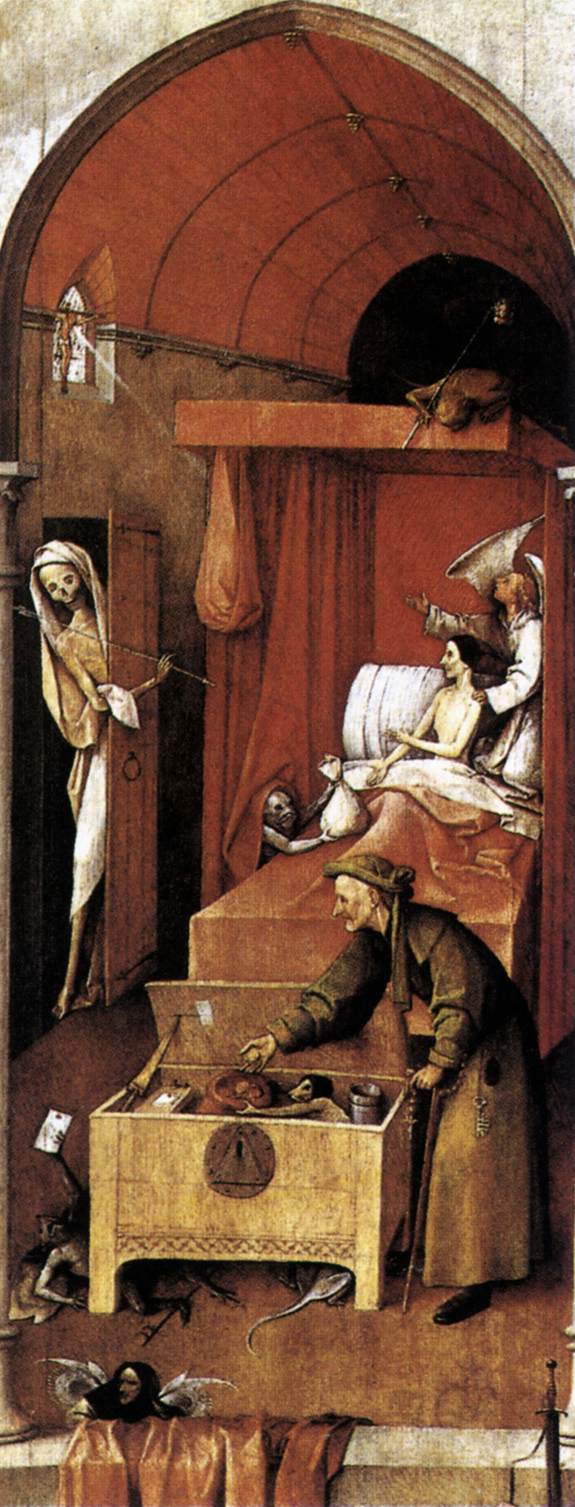
The Miser And Angel of Death


A miser had accumulated, by effort, trade and lending, three hunderd thousand dinars. He had lands and buildings, and all kinds of wealth. He then decided that he would spend a year in enjoyment, living comfortably, and then decide as what his future should be.

But, almost as soon as he had stopped amassing money the Angel of Death appeared before him, to take his life away.

The miser tried, by every argument which he could muster, to dissuade the Angel, who seemed, however, adament. Then the man said: "Grant me but three more days and I will give you one-third of my possessions."

The angel refused, and pulled again at the miser's life, tugging to take it away.

Then the man said:

"If you only allow me two more days on earth, I will give you two hundred thousand dinars from my store."

But the Angel would not listen to him. And the Angel even refused to give the man a solitary extra day for all his three hundred thousand pieces.

The the miser said:

"Please, then, give me just time enough to write one little thing down."


This time the Angel allowed him this single concession, and the man wrote, with his own blood:

"Man, make use of your life. I could not buy one hour for three hundred thousand dinars. Make sure that you realize the value of your time."

Source: Obtained from the book "The Way of the Sufi" by Idries Shah.

Importance of Saying Insha-ALLAH


During a Jumah Khutbah in a small town, an Imam talked about the significance of saying "Insha Allah" (which means if Allah wills) when planning to do something in the future. After a few days, a man who had also attended the Khutbah was going to buy a cow from the market. On the way, he met a friend who asked him where he was going. He told him about buying the cow but did not say Insha Allah in the end. His friend reminded him about the Khutbah and told him to say Insha Allah. However, this individual said that he had the money he needs and the energy to go to the market, thus, there is no point of saying Insha Allah as he will certainly buy the cow. He thought that saying Insha Allah will not make any difference.

When he reached the market, he found a cow that met his expectations. He burgained with the seller and came to a reasonable price. Finally, he decided to pay for the cow but was dumbfounded when he discovered that his money was missing.
A thief had stolen the money while he was walking through the busy market. The cow seller asked him whether he was going to buy the cow or not. "Insha Allah, I will buy it next week," he said. When he reached home, his wife inquired about the cow. He told her about how he forgot to say Insha Allah, and also added, "Insha Allah, I wanted to buy the cow. But Insha Allah, my money was stolen. Insha Allah, I will buy it next week." His wife clarified to him that we should say Insha Allah for things that are yet to happen, not for those things that had already happened. He never forgot his "Insha Allah" again.

This incident was narrated by Shaikh Wahidullah from Toronto, Canada.

A Young Man's Fear Of ALLAH


One day, Malik bin Dinar (rahimaullah) was passing by a place when he noticed a young man wearing old clothes and crying by the roadside. His name was Uthbah. Sweat was dripping down his body even though the temperature was very cold at that time. Malik bin Dinar became very surprised at this scene and asked Uthbah, "Oh young man, why are you crying? And why are you sweating during this cold temperature?"

Uthbah replied, "Once, I committed a sin at this place. Today, as I was passing by this place, I remembered that sin."

Source: Obtained from the book "Tambihul Ghafileen" by Shaikh Abul Laith Samarkandi.

Look how pious were the early Muslims. Today, we are committing thousands of sins, yet, we are walking around with happiness and joy as if we have nothing to worry about.

The King And The Poor Man


There was a king who decided to take a tour of his country. As he passed by different places, everyone rushed to see him. However, while passing by a certain place, he noticed a poor old man who did not pay any attention to the king's arrival and remained engaged in his own activities. The king went up to this poor man and asked why he did not join the people to see him. The poor man replied, "Before you, there was another king who once passed by this place. Everyone gathered to see him as well. But, few days later he died and was buried in a place nearby. A poor man also died during that time and was buried near the king's grave. After some time, a strong flood passed through that area causing those graves to overturn. As a result, the bones of the poor man became mixed up with those of the king's. We could not differentiate between them any longer. After seeing this, it does not matter to me anymore as to who is a king and who is a beggar. In the end, our home is the same."

Narrated by brother Ayyub from Toronto, Canada during one of his lectures.

The Patched Robe


There was a Jew of Damascus who was reading a holy book one day when he came across the name of the Prophet Muhammad (peace be upon him) written in it. Not liking this, he removed the name. But the next day he found it there again. Again he took out the name; but on the third day it had appeared again. He thought: "Perhaps this is a sign that a true Emissary has come. I will journey southwards to Madinah."

And he forthwith started out, not tarrying until he reached the city of the Prophet. When he arrived there, knowing nobody, he was near the Mosque of the Prophet when the Sahabi Anas (ra) arrived. He said to Anas: "Friend, take me to the Prophet."

Anas (ra) led him into the mosque, which was full of people in anguish. Abu Bakr (ra) the successor was sitting there at the head of the assembly. The old man went up to him, thinking he must be Muhammad, and said: "O Chosen Envoy of God, a strayed old man has come to offer you peace." Hearing the title of the Prophet used, everyone present burst into a flood of tears. The stranger was uncertain as to what to do. He said: "I am a foreigner and a Jew, and I am unaware of the rites of the Faith of Submission to the Will of Allah. Have I said something untoward? Should I have remained silent? Or is this a ritual observance? Why do you cry? If it is a ceremony, I have never heard of it."


Omar (ra) said to him: "We do not weep because of anything which you have done. But you must hear, unfortunate one, that it is a but a week since the Prophet left the earth. When we heard his name, grief took possession of our hearts anew."

As soon as he heard this, the ancient tore his clothes in anguish. When he had recovered a little, he said: "Do me one favour. Let me have at least a robe of the Prophet. If I cannot see him, at least let me have this."

Omar (ra) answered: "Only Fatima (ra) could give us one of his robes." Ali (ra) said: "But she will not allow anyone to go near her." But they went to her door and knocked, and explained what they wanted.

Fatima (ra) answered: "Verily, the Prophet spoke truly when he said, shortly before he died: 'A wayfarer, who has love towards me and who is a good man, will come to the house. He will not see me. Give him, therefore, this patchwork robe as if from me, and for me treat him gently, offering salutations.'"

The Jew put the robe on himself and, professing Islam, asked to be taken to the Prophet's grave. It was at this place that he breathed his last.

Source: From the book "Ilahi-Nama" by Shaikh Farid Al-Din Attar.

Owner Of the Garden


The following story is mentioned in Surah Qalam, Chapter 68 of the Holy Quran.

Once there was a wealthy and pious man. He had a big garden full of green trees laden with fruits. After the fruits were picked, this rightful man used to distribute some fruits among the poor who would gather at the garden every season to take their share.

Allah liked this act of the man. By the grace of Allah the garden used to give rich harvest every season. Truly, one who spends for the sake of Allah gets the reward in the hereafter as well as in this life.

This man had many sons who were not so pious as him. When their father died, they discussed a plan and said to each other that their father was not a wise man. He did not know how it was difficult to earn livelihood. They did not like the habit of distributing some of the fruits among the poor. They felt as if all their efforts would go to vain if the poor had some share.


One of the sons had a concern. What will they tell the poor people when they gather to take their fruits next time? They thought over its implications, as they were worried about losing their prestige. However, they were not afraid of Allah's wrath. One of them suggested removing all the fruits in the night and thus clearing the garden before dawn so that nobody could come and ask for his share. Everyone agreed to this suggestion. Since they were not even afraid of Allah, they forgot to say 'Insha-Allah', which means if Allah Wills, "...they swore to pluck the fruits of the (garden) in the morning, without saying Insha-Allah ('if Allah Wills')" (Verses 17-18). If a Muslim does not say Insha-Allah before doing something Allah may not fulfill his wish. But those who have no faith in Allah fail to remember this and get stuck up in their act.

Allah is all Powerful. He knows no bounds in His Governance. All the brothers went to sleep with a view to getting up early in the morning and gather the ripe fruits. In the meantime, with the Will of Allah "...there passed by on the (garden) a visitation (fire) from your Lord at night and burnt it while they were asleep." (Verse 19)

In the early morning, all of them got up and hurried up and "...called out one to another as soon as the morning broke, Saying: 'Go to your tilth in the morning, if you would pluck the fruits.' So they departed, conversing in secret low tones (saying), No Miskin (poor man) shall enter upon you into it today." (Verses 21-24)

As they were proceeding towards the garden, they were quite unaware that Allah had willed otherwise. Because the garden had become "black by the morning, like a pitch dark night (in complete ruins)" (Verse 20). So when they reached the garden, they said this was not their garden, and that they had strayed away from the right path to the garden. But when they saw there was no other way around, they were wonder struck! Soon they realized the situation and yelled: "Verily, we have gone astray," "Nay! Indeed we are deprived of (the fruits)!" The best among them said: "Did I not say to you 'Why not glorify (Allah)'?" (Verses 26-28). He had been advising them earlier against this act, for he had said it is only Allah who would enhance their fruits if they continued to give away some of them in charity.

All of them felt regretful over their misdeed. They turned, to one another, in reproach and said: "Glory to our Lord! Verily we have been doing wrong. Alas for us! We have indeed transgressed!" All of them, then, sought Allah's pardon and said: "We hope that our Lord will give us in exchange a better (garden) than this. Truly, we turn to our Lord (wishing for good that He may forgive our sins, and reward us in the Hereafter)." (Verses 31-32)

It is very beloved to Allah that we share with the less fortunate whatever we have. While some of us only feel hungry during the month of Ramadan, there are many who are hungry everyday. Let us be more generous with our wealth and help all those who are in need. We will not lose anything by giving away some of our wealth, we will only gain.

Only for ALLAH


There was a pious man among the Banu Israel who always remained busy in the worship of Allah. A group of people came to him and told him that a tribe living nearby worshipped a tree. The news upset him, and with an axe on his shoulder he went to cut down that tree. On the way, Satan met him in the form of an old man and asked him where he was going. He said he was going to cut a particular tree. Satan said, "You have nothing to be concerned with this tree, you better mind your worship and do not give it up for the sake of something that does not concern you." "This is also worship," retorted the worshipper. Then Satan tried to prevent him from cutting the tree, and there followed a fight between the two, in which the worshipper overpowered the Satan. Finding himself completely helpless, Satan begged to be excused, and when the worshipper released him, he again said, "Allah has not made the cutting of this tree obligatory on you. You do not lose anything if you do not cut it. If its cutting were necessary,
Allah could have got it done through one of his many Prophets." The worshipper insisted on cutting the tree. There was again a fight between the two and again the worshipper overpowered the Satan. "Well listen," said Satan, "I propose a settlement that will be to your advantage." The worshipper agreed, and Satan said, "You are a poor man, a mere burden on this earth. If you stay away from this act, I will pay you three gold coins everyday. You will daily find them lying under your pillow. By this money you can fulfil your own needs, can oblige your relative, help the needy, and do so many other virtuous things. Cutting the tree will be only one virtue, which will ultimately be of no use because the people will grow another tree." This proposal appealed to the worshipper, and he accepted it. He found the money on two successive days, but on the third day there was nothing. He got enraged, picked up his axe and went to cut the tree. Satan as an old man again met him on the way and asked him where he was going. "To cut the tree," shouted the worshipper. "I will not let you do it," said Satan. A fight took place between the two again but this time Satan had the upper hand and overpowered the worshipper. The latter was surprised at his own defeat, and asked the former the cause of his success. Satan replied, "At first, your anger was purely for earning the pleasure of Allah, and therefore Almighty Allah helped you to overpower me, but now it has been partly for the sake of the gold coins and therefore you lost."

Source: From the book "Ihyaa-ul Uloom Ud Deen" by Imam Ghazzali (ra).

Story of Alexander the Great


Alexander the Great is known as the most powerful military leader and conqueror of the ancient world. Before he turned 30 years old he conquered an empire stretching over 3,000 miles from Greece to India. He was born in 356 BC in Macedonia, known today as northern Greece.

On his sickbed and during his last hour alive, Alexander the Great told his generals "After my death, when you put my body in the casket, let my arms hang over the edges with my palms wide open, so the public can see my empty hands while I am leaving the world." After he died, many dignitaries came to view the royal funeral and were very surprised to see his arms hanging over the edge of the casket with his palms wide open. They asked questions about this unique scene. A wise man told them "O People, Alexander the Great is telling us that when he ruled the world, great treasures of gold, silver and wealth came to be under his possession. Yet, indeed he is leaving the world empty handed."

Source: Partially extracted from the writtings of JC Pinkerton.


Anas bin Malik, may Allah be pleased with him, reported: Allah's Messenger (may peace be upon him) said: Three things follow the bier of a dead man, two of them come back and one is left with him: the members of his family, wealth and his good deeds. The members of his family and wealth come back while his deeds alone are left with him. (Sahih Muslim)

Story of a Wrestler Junaid Baghdadi


Junaid Baghdadi earned his livelihood as a professional wrestler. As was the norm, the Leader of Baghdad announced one day, "Today, Junaid Baghdadi will demonstrate his skills as a wrestler, is there anyone to challenge him." An elderly man shakily stood up with his neck quivering and said, "I will enter the contest with him."


Whoever was witness to this scene could not contain themselves, they burst out howling with laughter, clapping their hands. The King was bound by the law. He could not stop someone who of his own free will entered the bout. The elderly man was given the permission to enter the ring. He was about sixty-five years old. When Junaid Baghdadi entered the ring, he was dumbfounded as was the King and all the spectators of the Kingdom who were present. The single thought that occupied their minds was, "How will this old man be able to fight?"

The old man addressed Junaid with these words, "Lend me your ears." He then whispered, "I know it is not possible for me to win this bout against you, but I am a Sayyid, a descendant of Prophet Muhammad (peace be upon him). My children are starving at home. Are you prepared to sacrifice your name, your honour and position for the love of Allah's Prophet and lose this bout to me? If you do this I will be able to collect the prize money and thereby have the means to feed my children and myself for an entire year. I will be able to settle all my debts and above all, the master of both the worlds will be pleased with you. Are you, Oh Junaid, not willing to sacrifice your honour for the sake of the children of Rasulullah (peace be upon him)?"

Junaid Baghdadi thought to himself, "Today, I have an excellent opportunity."

In a display of fervour Junaid Baghdadi executed a couple of maneuvers, demonstrating his finesse so that the King does not suspect any conspiracy. Junaid with a great display of antics did not use his strength and allowed himself to be dropped. The elderly man mounted his chest thus entitling him to the prize.

That night, Junaid Baghdadi had a dream of Prophet Muhammad (peace be upon him) who said, "Oh Junaid, you have sacrificed your honour, your nationally acclaimed fame, your name and position which was heralded throughout Baghdad in the expression of your love for my children who were starving. As of today, your name is recorded in the register of the Auliya (friends of Allah)."

Thereafter, this great wrestler learnt to defeat his nafs (desires) and became one of the most eminent Auliya of his time!

Source: From the book "Tajalliat-e-Jazb" by Shaikh Hakim Muhammad Akhtar.